Stake-Only Loyalty Program: Premium and Points
Premium, INO and XTC utility, daily points and listed communities: how Stake-Only’s optional programme fits around a CRO position.
· Kcalb Ltd Team
Stake-Only’s Loyalty Program sits alongside CRO staking on Cronos POS. It combines an optional Premium pool, listed-community token pools and a public record of eligibility, points and distributions. Each component has its own conditions; staking with the validator does not enrol a user automatically.
This guide follows the programme from wallet holdings to daily snapshots and recorded rewards. It explains the utility of INO and XTC, the role of Wrapped Bitcoin on Cronos EVM, Role and Seniority coefficients.
CRO staking takes place on Cronos POS. Cronos EVM is the separate smart-contract network used here for INO, XTC and WBTC. CRO is the native asset on both networks; token holdings and transactions must be checked on the relevant network. For the staking controls and reinvestment example, read How to Manage a CRO Staking Position on Cronos with Stake-Only.
The staking position and programme membership are separate decisions. Flexible CRO and one-, two- or four-year CRO locks are managed through the staking controls. A Loyalty Program membership term does not create or extend one of those locks.
Joining the optional programme
- Delegate CRO and activate Restake. Meet the current delegated-CRO minimum shown by the platform.
- Link the Cronos EVM wallet that holds your qualifying tokens. This is the address used to assess supported token holdings and receive programme distributions.
- Activate the Loyalty Program membership. Read its term, renewal conditions and the rules for the pools you want to join.
- Check Hold and the daily snapshots. Premium requires the applicable INO and XTC holdings; listed communities follow their own token minimums. Confirmed eligibility requires two consecutive qualifying daily snapshots.
Staking and Restake can be used without joining this programme. The published programme documentation sets out the current rules.
Premium, listed communities and the assets involved
The optional Loyalty Program extends the experience through Premium and listed-community pools. The underlying staking rewards remain CRO. Additional programme rewards follow their own assets, eligibility requirements and distribution rules. They should be read as separate parts of the position.
One CRO position, three complementary tokens
CRO remains CRO on Cronos POS and Cronos EVM; the two networks are not counted as different assets. Around that CRO staking position, the programme uses three complementary tokens: INO, XTC and Wrapped Bitcoin (WBTC). The links below lead to the official projects and the relevant on-chain records.
Cronos · CRO
CRO is the native asset delegated on Cronos POS. It earns the base staking rewards and, for eligible locked principal, the network Lock Bonus.
 About CRO
InoAi · INO
INO holdings contribute to Premium eligibility and Roles. INO is also one of the assets distributed through the Premium reward pool.
 InoAi website
Xitcoin · XTC
XTC holdings contribute to Premium eligibility and Roles. The programme also builds a separate XTC reserve connected to the Xitcoin ecosystem and its live Xitcoin Vault on Cronos EVM.
 Xitcoin website
Wrapped Bitcoin · WBTC
WBTC is a tokenised form of Bitcoin. Here it is held and distributed on Cronos EVM, using the specific Cronos token contract linked below. It is a separate asset from CRO, INO and XTC—not native BTC sent over the Bitcoin network.
 WBTC on Cronos · token & contract
INO, XTC and the WBTC shown here use Cronos EVM. CRO delegation uses Cronos POS. A token’s network and full contract address identify the asset; its logo alone does not.
INO and XTC: two utility tokens in the Premium mechanism
Within Stake-Only, InoAi (INO) and Xitcoin (XTC) have a defined programme utility: their recognised holdings form part of Premium eligibility and determine the Role used in its points calculation. They are not just names attached to the account. Full Premium access requires the applicable delegated CRO minimum and both the required INO and XTC holdings, together with the other participation conditions. The required quantities are visible in Hold and the public Explorer.
The two tokens have related but different functions. XTC holdings contribute to eligibility and Role; the programme’s separate reserve strategy also supports the Xitcoin ecosystem and the live Xitcoin Vault on Cronos EVM. INO contributes to eligibility and Role and is also an asset distributed through the Premium pool. Eligible members can receive INO and Wrapped Bitcoin (WBTC). WBTC is a wrapped asset on Cronos EVM, not native bitcoin sent to a Bitcoin address. The Premium guide identifies the eligibility assets and distribution assets separately.
There are two distinct thresholds to read. Premium access minimums are recalculated daily using market prices and are displayed as token quantities. Role thresholds are fixed token quantities set by the programme. Each Role has its own rule, under which one token may suffice or both may be required. A Role does not replace the need to meet both token minimums for full Premium access.
Roles: how recognised INO and XTC holdings weight Premium points
The highest Role whose holdings conditions are satisfied applies at the daily snapshot. It can move up or down as recognised holdings change. Wallet balances and supported liquidity, staking, lock or farm positions are included only where the underlying tokens can be verified. The exact quantities and each Role’s rule are shown in Hold and the Explorer.
| Role | Published Premium points coefficient | Meaning in the calculation |
|---|---|---|
| Newbie | No points under the published role description | The required core-token quantities for a points-bearing Role are not met. |
| Holder | ×1.1 | Entry points-bearing Role, subject to its holdings rule. |
| Bull | ×1.5 | Higher weighting once the corresponding holdings rule is met. |
| Whale | ×2.0 | Highest published Role weighting, subject to its holdings rule. |
Role weights Premium points only. It does not multiply the CRO staking rate or Lock Bonus, and does not affect listed-community points or access. These are distinct parts of the programme. Published Role rules.
Seniority: the coefficient earned through uninterrupted participation
The Seniority coefficient follows time spent in uninterrupted active Loyalty Program membership. It applies to both Premium and listed-community points. It is separate from Role, lock duration and the membership term selected at entry.
| Seniority level | Uninterrupted membership reached | Coefficient |
|---|---|---|
| Ruby | From entry | ×1.0 |
| Emerald | 1 year | ×1.5 |
| Carnelian | 3 years | ×2.0 |
| Sapphire | 6 years | ×2.5 |
| Diamond | 9 years | ×3.0 |
Selecting a ten-year membership does not grant the nine-year coefficient immediately. Time must actually pass with the membership active and uninterrupted. Leaving the programme or allowing membership to expire resets the Seniority counter. A change in token eligibility must also be distinguished from ending membership: losing Premium eligibility pauses new allocations under the applicable snapshot rules. Published Seniority rules.
How a CRO position and Premium points evolve together
A participating member can have three components: original delegated CRO, a flexible balance built from restaked gains, and separate Premium allocations while the required INO and XTC holdings are maintained. Recognised delegated CRO, including locked CRO and the gains delegated into flexible staking, enters the points calculation at the snapshot.
Premium points = recognised delegated CRO × Role coefficient × Seniority coefficient
The staking balance can grow through reinvestment, while Role weights that balance and Seniority changes with uninterrupted membership. These effects combine in the points calculation; Premium rewards remain separate assets, not an added fixed CRO interest rate.
For a self-contained illustration, start with a $10,000 CRO position at a reference price of $0.05931, or approximately 168,606 CRO, locked for four years. Assume a constant 3.27% net annual base staking rate, a 7% annual Lock Bonus on the original principal for those four years, and daily reinvestment of the collected gains into flexible staking at the base rate. After year four the bonus ends; the model assumes no renewed lock. It uses 365-day years, no deposits or withdrawals, and excludes taxes and user transaction fees. These are calculation assumptions, not a forecast.
The points table assumes Bull Role (×1.5) throughout, uninterrupted membership and full Premium eligibility at the relevant snapshots. INO and XTC are additional holdings, not purchases included in the $10,000 CRO starting amount. The CRO balances below illustrate compounding; the points alongside them illustrate allocation weights, not guaranteed rewards.
| Year of continuous membership | Illustrative delegated CRO | Seniority | Illustrative Premium points · Bull ×1.5 |
|---|---|---|---|
| Entry, once eligible | 168,606 | ×1 | 252,908 |
| 1 | 186,207 | ×1.5 | 418,965 |
| 3 | 223,184 | ×2 | 669,552 |
| 4 | 242,599 | ×2 | 727,798 |
| 6 | 258,995 | ×2.5 | 971,230 |
| 9 | 285,689 | ×3 | 1,285,600 |
| 10 | 295,185 | ×3 | 1,328,332 |
For example, at the four-year point the model has about 242,599 delegated CRO. Bull Role (×1.5) and Carnelian Seniority (×2.0) produce about 727,798 Premium points. The combined weighting is ×3 of the recognised CRO quantity. It does not mean three times the staking yield or a guaranteed threefold token distribution.
From points to an actual share of Premium assets
A member’s daily share is their Premium points divided by all eligible Premium points for that day. That fraction is applied to the distributable amount of each Premium asset. For a simple arithmetic example, 30,000 points out of a total 1,000,000 eligible points give a 3% share. If a purely illustrative daily pool contained 1,000 INO and 0.01 WBTC, that share would correspond to 30 INO and 0.0003 WBTC, or 30,000 satoshi-equivalent units of WBTC. These invented pool amounts explain the calculation; they are not reported distributions or projected earnings.
The actual result depends on the assets available in the pool and everyone else’s eligible points. Other members can also increase their stake, Role or Seniority, so a growing personal points total does not automatically mean a growing percentage share. No fixed Premium dollar return is added to this ten-year illustration.
This is the connection between the interface’s controls: Stake manages the CRO position, Hold explains the INO/XTC holdings and eligibility, Program tracks active membership, Snapshot records Role, Seniority and daily points, and History shows the INO/WBTC amounts actually credited and sent. Premium eligibility must be confirmed across two qualifying daily snapshots; already credited rewards retain their published treatment if new eligibility is lost.
Listed communities: holdings and reward-pool eligibility
A listed community has its own token reward pool. An eligible holder can retain that token on the linked address and participate alongside a CRO delegation. The programme itself does not require those community tokens to be locked or transferred away. Supported liquidity and staking positions can also count when their underlying holdings can be verified; each external pool or farm still has its own rules.
This creates a route for communities whose holders want to remain involved while receiving an additional flow of tokens. Premium is a separate pool: it is not a requirement for listed-community participation, and members who qualify for both can share in both.
What the 60/40 rule actually means
The current rule allocates 60% of the daily listed-token purchase budget to the leading eligible community. The remaining 40% is shared equally between the other communities with eligible members. It is a split of that purchase budget, not 60% of all validator revenue or a promised return for an individual.
The published listing rules rank eligible holders’ collective token holdings relative to the day’s minimum. It does not measure social followers or likes. Market prices affect the minimum quantities, which can change the ranking even when the underlying balances have not moved. Communities without an eligible member are excluded from that day’s purchases.
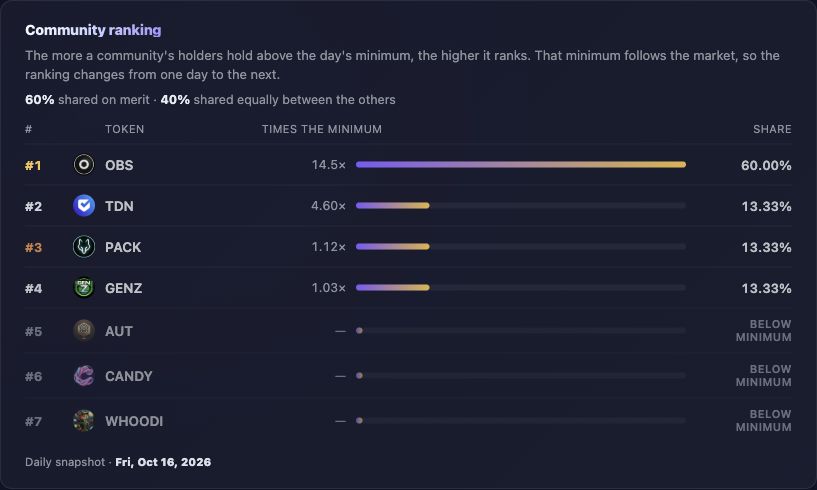
Listings can be added, updated, suspended or removed as communities and their eligibility evolve. Being listed is not a permanent promise of funding. The published rules explain how existing credited rewards are handled when a listing ends. The active list and the live thresholds are therefore part of the information a holder should check.
Update, 21 October 2026: the Xitcoin Vault is now live on Cronos EVM, with lock terms from 180 days to 10 years. Its staking positions can be verified through contract 0x7396C304bC7Ba6B169F8aC230C9e63Da8B77Fd15, and the live interface is available at https://xitcoin.com/#earn. Native staking on XitChain remains a future step while XitChain is still in development.
Hold: holdings and a dynamic minimum
Hold is where the market’s movement becomes relevant to a member’s eligibility. The screen brings together the quantity a person holds and the quantity required for a particular token’s pool. It lets the member see whether the position sits below, at or above the current minimum.
Total held means the person’s total qualifying token holding. It is not the token’s total supply. The programme reads the linked wallet together with supported positions: V2 liquidity pools, the underlying amounts in recognised V3 positions, and supported staking, lock or farm contracts. The position breakdown shows which holdings have been included. An unrecognised contract cannot simply be assumed to count.
| Hold column | How to read it |
|---|---|
| Token · Blockchain | The asset being tracked and the network on which the qualifying position is read. |
| Total held | The combined quantity recognised for the linked address and its supported positions. |
| Minimum | The required token quantity for the applicable daily snapshot. It can change as market prices and programme parameters change. |
| Vs minimum | The surplus or shortfall against that quantity. The guide describes green for a position above the minimum and red for a position below it. |
| Points · Share | The points associated with the position and its share of the relevant reward pool when eligible. |
| Status | The confirmed eligibility state, including the requirement to meet the conditions at two consecutive daily snapshots. |
A threshold that follows the market
Token prices rise and fall. As those prices move relative to the programme’s reference, the required quantity is recalculated. A balance can therefore remain unchanged while its distance from the threshold changes. The quantity needed for eligibility may rise or fall; the same holding is not permanently above the minimum just because it qualified yesterday.
Hold makes the consequence visible through quantities. It is a view of how market movements affect programme eligibility, rather than a prediction of the token’s future price. The current minimum and the member’s recognised holding must be read together.
| Illustrative holding | Today’s illustrative minimum | Position against that minimum |
|---|---|---|
| 1,500,000 tokens | 2,000,000 tokens | 500,000 below the required quantity |
| 2,000,000 tokens | 2,000,000 tokens | At the required quantity |
| 2,200,000 tokens | 2,000,000 tokens | 200,000 above the required quantity |
These are illustrative quantities for an unnamed listed token, not a published threshold for a particular asset. If a later day requires 2,300,000 tokens, the unchanged 2,200,000-token position is then 100,000 below the new minimum. If the requirement falls to 1,900,000, that same holding is 300,000 above it.
The UTC snapshot records the qualifying position
The platform’s published schedule places the Daily Snapshot at 19:00 UTC, after the preceding Restake operation. The Explorer displays the current schedule, including any operational delay. At that reading, the programme records delegated CRO, recognised token holdings and the factors used for the day’s points.
Reaching a token’s minimum is one condition. Confirmed access also depends on the applicable delegated CRO minimum, active Restake, active membership and the linked address. Eligibility requires two consecutive qualifying snapshots. A position that falls below the requirement does not receive a new allocation from that pool while ineligible; already credited rewards follow the published programme rules.
For an eligible member, the points determine a share of the tokens available in the relevant pool. Those tokens are acquired or drawn from existing reserves through the validator-funded programme. The portion allocated to a person depends on that day’s eligible position and the total eligible points in that pool. It is not a fixed quantity reserved forever by holding a particular token.
The Hold guide and the public Snapshot records let users trace that relationship: recognised holding, required minimum, eligibility, points and the portion allocated.
Membership time is not a CRO lock
This distinction deserves its own line: choosing a Loyalty Program membership term does not, by itself, lock the CRO. A staking lock governs the availability of principal. A membership term governs continued programme participation. They are separate controls.
Participation requires Restake, a linked Cronos EVM address and the applicable holdings. Eligibility is checked across two consecutive daily snapshots. The linked address receives the additional token distributions, and the current requirements are shown in Account. A member’s share can change as the position, eligible holdings or other participants change.
How daily points and pool shares are calculated
The daily snapshot turns each eligible position into points. A larger CRO delegation increases the points when the other factors stay the same. Continued participation builds seniority, and qualifying INO/XTC holdings determine the Role used for Premium.
Premium points = delegated CRO × Role coefficient × seniority coefficient
Listed-community points = delegated CRO × seniority coefficient × (eligible token holding ÷ day’s minimum)
For example, doubling a delegation from 10,000 to 20,000 CRO doubles the corresponding daily points if all the other factors are unchanged. It does not guarantee a doubled payout: the share is calculated against everyone else’s eligible points in that pool, and the amount of tokens available also varies.
Daily points allocate that day’s rewards. Cumulative points record longer-term participation. The distinction makes the programme easier to read: a leaderboard history is not an account balance, while the snapshot explains the factors behind a day’s share.
How validator commission funds operations and ecosystem reserves
The validator commission is established at 20% to support the operation and funding of this system. It is applied to generated staking rewards, while the delegated principal stays with the owner. The published documentation states that the additional network Lock Bonus carries no validator commission.
That operating commission supports the architecture behind the service: automated execution, growth of the staking base, and the reserve allocations used to acquire and distribute additional tokens. The validator covers the daily Restake execution fees; gas reserves are funded from the company’s share. Eligible members can then participate in the programme’s additional distributions, according to their holdings and points. This funding connects the validator’s activity with additional reward streams and long-term ecosystem growth; each member’s allocation follows the programme rules.
The financial direction is broader than the current list of communities. Validator commission feeds reserves for CRO growth, Premium asset purchases and listed-token purchases. Current operating allocations can evolve and should be checked directly in the public Vaults screen.
The published treasury guide then describes a further split inside the CRO growth reserve. It is important to keep the two levels separate:
| Share of the growth reserve | Current direction |
|---|---|
| 35.9% | Reinvested on the validator to increase its staking base |
| 30.8% | Sent in CRO to INO to support the ecosystem strategy |
| 17.9% | Converted to XTC for the external staking reserve |
| 15.4% | Used to build the WBTC/XTC liquidity position on VVS |
This is why the model continues to concentrate on CRO, Xitcoin and InoAi with or without any particular listed token. Growing the validator’s own stake strengthens its productive base. Supporting INO and XTC keeps the broader development direction connected to that activity.
INO is the Strategy Analyzer at Kcalb Ltd and the entity described at the centre of the programme’s strategy. The public Explorer also records an INO delegator position and its staking activity. Treasury reinvestment and that visible participation make the long-term direction easier to follow than a slogan alone.
The XTC reserve supports the Xitcoin ecosystem. The Xitcoin Vault is live on Cronos EVM with lock terms from 180 days to 10 years. Native staking on XitChain remains a future step while XitChain is still in development. Discover the project at Xitcoin’s official website.
The WBTC/XTC liquidity position is another part of this direction: it builds on-chain liquidity progressively rather than treating all production as immediately distributable rewards. Its pool and the programme’s share are publicly inspectable.
How the programme is intended to develop
The publisher’s roadmap includes opening validator positions in other blockchain ecosystems. The intended model would direct a share of their income into Premium reward pools to broaden the programme’s sources of funding and reinforce the utility of the qualifying INO and XTC holdings. The networks, deployments, revenue share and available distributions remain to be established. This is a development direction, not income presented as already active or assured.
Stake-Only is also being developed towards a wider INOLAH connection. Users can follow the current rules and public records through the documentation and Explorer. Official updates are available through KcalbApp, X and Discord.
Returns are not guaranteed. Programme distributions depend on eligibility, available funds and other members’ points. Cryptoasset prices and reward amounts can change. Wrapped assets, supported pools and staking positions carry their own network and technology risks. Read the terms before participating.
Publisher note. InoTimes and Stake-Only belong to the Kcalb ecosystem. This programme guide is published by Kcalb Ltd and is not an independent third-party review. It uses public documentation checked on 21 October 2026 and screenshots captured on 16 October 2026 (UTC); no wallet transaction, staking deposit or lock was executed for this article. The screenshots and illustrative calculations are dated references.