How to Manage a CRO Staking Position on Cronos | Stake-Only
Flexible CRO staking, optional lock terms and daily Restake: a practical guide to managing the position and reading the public Explorer.
· Kcalb Ltd Team
Cronos in brief: POS and EVM
Cronos is a family of blockchain networks powered by CRO. For this guide, two networks matter: Cronos POS, where holders delegate native CRO to validators and earn staking rewards, and Cronos EVM, the Ethereum-compatible network used for smart contracts, applications and tokens. CRO is the native asset on both networks, but their addresses and transactions follow different network rules. Stake-Only manages CRO staking on Cronos POS; its optional token distributions, including INO and Wrapped Bitcoin (WBTC), use Cronos EVM.
Stake-Only brings CRO delegation, reward collection and daily restaking into one account interface on Cronos POS. Its public Explorer lets readers inspect the activity behind those controls without connecting a wallet.
The central distinction is between the original stake and the flexible balance built from reinvested rewards. A lock follows its agreed term; its collected gains can be restaked separately and earn staking rewards in turn. The following guide explains those choices, the account screens and a worked four-year example.
Stake-Only operates under a provisional name while a wider connection with the INOLAH application is being developed. That integration remains a plan; the standalone platform is the service described here.
The Android application is available on Google Play. Published by KcalbApp, it provides access to position management, the public Explorer and the optional Loyalty Program.
 Download Stake-Only on Google Play
Getting started: four decisions, one CRO position
The tables and transaction records make the platform’s activity visible to the community. Getting started does not require studying every table. The position itself follows a short sequence:
- Connect your Cronos POS wallet and choose the CRO amount. Check the validator, the transaction details and the applicable minimums before signing.
- Choose flexible staking or an optional lock. Stake-Only displays one-, two- and four-year terms alongside flexible staking. The commitment and withdrawal rules differ; locking is a separate choice.
- Activate Restake if you want daily reinvestment. Read the requested authorisations. Once active, collected staking rewards and eligible lock gains are added to flexible stake.
- Follow and manage the position. Overview shows the balances, History records operations, and Stake, Claim and Unstake provide the relevant controls. The public Explorer helps trace the underlying activity.
Staking and Restake do not require Loyalty Program membership. Premium and listed-community distributions are optional mechanisms with separate holdings and participation conditions, explained in the programme guide.
Your wallet remains under your control; delegation does not give Stake-Only its keys. Lock terms, transaction permissions and the unbonding period still apply. INO, the guide in the bottom-right corner, can help users find the relevant screen. The step-by-step documentation and KcalbApp Discord provide further support.
Position management on Cronos POS
CRO delegation on Cronos POS supports the network’s validators and earns native staking rewards. Stake-Only adds a management interface around that activity, with dedicated actions for staking, claiming, compounding and unstaking. Cronos POS staking documentation.
Keeping those actions separate helps answer a basic question: what is being changed? Claiming a reward is different from withdrawing the original stake. Reinvesting gains is different from committing capital to a longer lock. A useful dashboard should make those distinctions easy to follow.
The Account interface groups position management, programme participation and transaction history in one place. Its Hold and Simulator sections help users inspect eligibility and explore scenarios. A simulation is a planning aid; it does not establish what the position will earn.
A guided tour of the Account pages
The Account is organised around decisions a delegator actually makes. Some pages change the position after a wallet signature; others explain its current state. The layout lets a user move from a broad overview to the figures behind a particular action.
| Page | What it helps you manage or understand |
|---|---|
| Overview | The position at a glance: delegated CRO, daily points, Role, seniority, membership status and the different reward streams. |
| Stake · Claim · Unstake | Delegate, collect or reinvest gains, and manage a withdrawal. Available CRO, flexible stake, locked stake, pending rewards and lock gains are shown separately. |
| Program | Restake activation, the membership term, its expiry and renewal. This is the control page for continued participation. |
| Profile | The member’s public identity, card and social links. Participation can be shared while position management remains tied to the wallet. |
| Hold | The total qualifying holding for each tracked token, today’s required quantity, the distance from that minimum and the associated eligibility status. |
| Simulator | Explore different amounts and time horizons. The ×1, ×10 and ×100 controls also test how a larger participating community could dilute a share. |
| Validators | Compare Cronos POS validators, commission and the displayed staking rates, with the programme’s effective estimate identified separately. |
| Chart | Follow the history of the position: delegated CRO, cumulative points and recorded INO/XTC holdings, each using its own scale. |
| History | Separate position activity from programme distributions. Read amounts, daily points, pool share, credited or sent status, and transaction references. |
This gives the interface a useful progression: Overview answers “where am I?”, Hold answers “what do I qualify for?”, and History answers “what actually happened?”. The Account guide explains the fields in detail.
How daily restaking works
Restake is the automation at the centre of the experience. Once authorised, it reinvests staking rewards daily. It also collects the gains of eligible locks and adds them to the flexible stake. The validator covers the daily execution fees; activation and the user’s own transactions still involve network fees. Restake can operate without joining the Loyalty Program. Restake guide.
The effect is straightforward. A reward left unclaimed waits in the pending balance. A reward put back into the stake contributes to the amount earning the next rewards. Repeating that process builds a compounding position without requiring the same manual action every evening.
One locked principal, a second balance built from its rewards
The distinction is central to Stake-Only’s workflow: the original locked capital and the flexible balance created by its rewards are two separate parts of the position. During a four-year lock, the original CRO earns staking rewards and the applicable Lock Bonus. With Restake authorised, both are collected daily and delegated as flexible CRO. That growing flexible balance then earns its own staking rewards, which Restake also reinvests.
Principal earns base staking rewards and the four-year Lock Bonus. Its amount and end date remain unchanged.
Receives the lock’s collected rewards and bonus, then generates and reinvests its own staking rewards.
Restake moves the gains into a second productive balance; it does not enlarge or extend the original lock. The newly staked gains do not automatically receive a four-year bonus. That would require a separate, deliberate new lock.
What the delegator can manage
The owner can inspect both balances, leave the gains in flexible staking, request their unstaking subject to the 28-day unbonding period, or create a separate new lock of at least 100 CRO with its own end date. The original principal remains unavailable for withdrawal until its existing lock ends. Restake authorisation can be cancelled; ending it does not shorten a lock or remove the unbonding period.
At the original maturity date, the Lock Bonus stops while the CRO stays staked and continues earning base staking rewards. Unlocking is a separate wallet action. Renewing a lock is another decision, not an automatic extension. These controls are documented in the Lock Bonus guide.
The CRO compounding cycle is separate from Premium and listed-community distributions. INO, WBTC and other distributed tokens remain their own assets; this explanation does not assume that they are automatically converted into CRO and restaked.
Automation still needs a decision from the wallet owner. The documentation explains the permissions and how to revoke them. It describes permissions for staking and collecting lock gains, rather than transferring the owner’s CRO to another address. Those permissions should be read before signing.
Flexible staking, lock terms and withdrawal
The current interface offers flexible staking alongside locks of one, two or four years. Cronos publishes corresponding additional annual bonus rates of 2%, 4% and 7%. These are bonus components, not the complete return from a position. Base rewards, commission and network conditions also matter. Cronos tiered staking model.
| Position | Published additional annual bonus | Commitment shown by Stake-Only |
|---|---|---|
| Flexible | No lock bonus | Unstake, then wait through the 28-day unbonding period |
| 1-year lock | 2% | Locked principal until the displayed end date |
| 2-year lock | 4% | Locked principal until the displayed end date |
| 4-year lock | 7% | Locked principal until the displayed end date |
Stake-Only specifies a 100 CRO minimum for a lock. At maturity, unlocking returns the principal to normal staking; withdrawal then requires the standard 28-day unbonding period. With Restake active, lock gains enter the flexible stake, rather than extending the original lock. Lock Bonus guide.
That separation is useful when thinking about a position over time: the principal follows its agreed horizon, while reinvested gains build a separate flexible component. Before committing, the end date and withdrawal timeline deserve as much attention as the displayed rate.
Reading APR, APY and the different reward components
The CRO position combines base staking rewards, any applicable network Lock Bonus and the effect of reinvesting collected gains. Commission, network conditions, lock terms and the timing of reinvestment affect the result. The account displays the components separately.
APR and APY describe different measures. APR is a simple annualised rate; APY includes compounding. A comparison is useful only when it uses equivalent lock durations, commission treatment and reinvestment assumptions. Additional-token distributions through the optional Loyalty Program are separate assets and are not treated as an extra fixed CRO rate. The rate methodology explains the displayed estimates.
A four-year lock: seeing the two balances compound
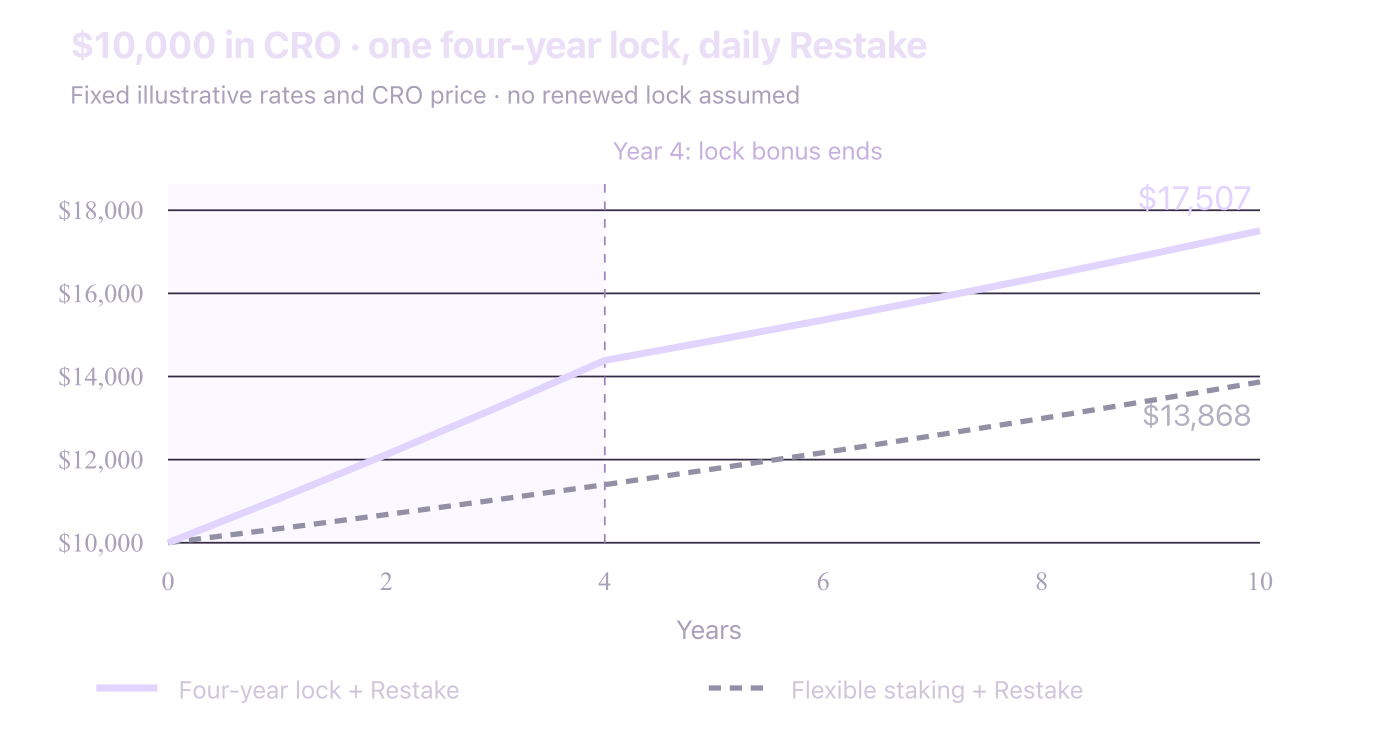
The Account’s Simulator helps compare staking, reinvestment, membership and reward-pool shares over time. The following worked example focuses on a $10,000 CRO position locked for four years, with the gains restaked daily into flexible staking. It shows the two parts of the position rather than treating the entire balance as if it received the lock bonus.
The initial CRO reference price is $0.05931, corresponding to about 168,606 CRO. The illustration retains the dated 3.27% net annual base-staking assumption used for this calculation and adds the published 7% annual four-year Lock Bonus on the original locked principal. Together these make an illustrative 10.27% annual reward flow on that principal during its lock. The flexible gains earn the assumed 3.27% base rate, not 10.27%. The base assumption is already after validator commission; no second commission deduction is applied, and the published Lock Bonus has no validator commission.
Under those assumptions, the original position produces about 47.44 CRO per day before rewards generated by the growing flexible balance. Restake moves the collected CRO into flexible staking. The next cycle therefore includes rewards from the original locked position and rewards from the flexible balance built so far.
| Year | Original principal | Flexible CRO built from reinvested gains | Total value at unchanged CRO price |
|---|---|---|---|
| 0 | 168,606 CRO | 0 CRO | $10,000 |
| 1 | 168,606 CRO | 17,601 CRO | $11,044 |
| 2 | 168,606 CRO | 35,787 CRO | $12,123 |
| 3 | 168,606 CRO | 54,578 CRO | $13,237 |
| 4 | 168,606 CRO | 73,994 CRO | $14,389 |
| 10 | 168,606 CRO | 126,579 CRO | $17,507 |
At the end of year four, the illustration has about 73,994 CRO in the separate flexible balance, alongside the original 168,606 CRO. Combined, that is about 242,599 CRO, or $14,389 at the unchanged reference price. The original lock has not been topped up or extended by the reinvestment.
Separating the lock bonus from the compounding effect
A comparison at the same four-year date separates the bonus earned by locking from the extra rewards generated by reinvesting the gains:
| Illustrative four-year scenario | Total at unchanged CRO price | What is included |
|---|---|---|
| Flexible staking with daily Restake | $11,397 | Base staking rewards and their daily compounding; no lock bonus. |
| Four-year lock without reinvesting gains | $14,108 | Original principal plus base rewards and lock bonus. Gains are counted but held outside staking and earn nothing further in this comparison. |
| Four-year lock with daily Restake | $14,389 | The same original lock and reward flow, plus staking rewards generated by the separately reinvested flexible gains. |
In this model, about $281 of the difference is attributable to compounding the lock’s collected gains over four years. The rest of the difference from flexible-only staking comes from the Lock Bonus. Keeping these effects separate explains what the lock contributes and what Restake adds.
Continuing the illustration to ten years
The graph continues for six years after the initial four-year lock ends, without assuming a renewed lock. The original principal remains staked, but its 7% bonus ends at maturity. Base staking rewards from both parts continue to be restaked at the assumed 3.27% rate. This gives about 295,185 CRO at year ten, worth $17,507 only if the CRO price stays unchanged.
The same year-ten token balance would instead be worth about $8,754 if CRO’s price were half the initial reference, or $26,261 if it were 50% higher. More CRO and a higher cash value remain separate outcomes. The fixed rates used here are assumptions, not a ten-year forecast.
The owner may choose a separate new lock for flexible gains or unlock and renew the original principal after maturity. Either action changes the commitment and requires a new decision; neither is assumed in these figures. A ten-year Loyalty Program membership is also separate from the four-year CRO lock.
Premium and listed-community distributions are not included. INO, XTC and other qualifying holdings are separate assets, and the model does not assume conversion of their rewards into CRO. Simulator documentation.
A hybrid Explorer, with links back to the chains
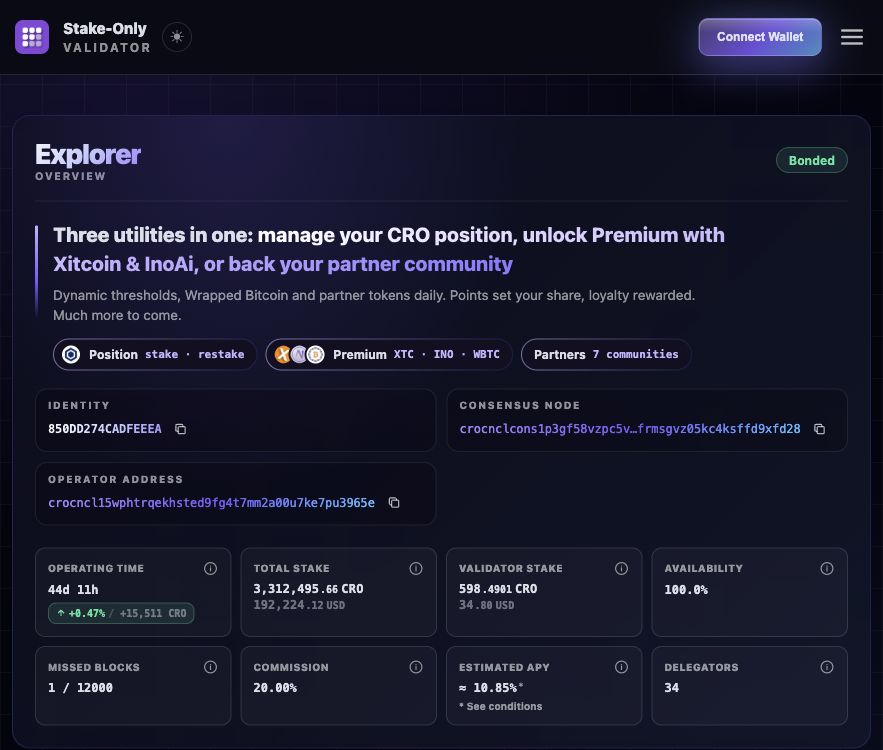
The public Explorer is one of the most useful starting points. During this review, it displayed staking and lock activity, Restake operations, INO and WBTC Premium distributions, and listed-token distributions. Entries include links to transaction records.
The 20% operating commission and its reserve allocations can be inspected publicly. An estimated APY should be read with its conditions, especially where the estimate includes more than native staking. The site’s hybrid Explorer brings staking on Cronos POS and token activity on Cronos EVM into one view. Its links let users inspect the underlying records on the Cronos POS validator Explorer and the Cronos EVM treasury Explorer. Both the consolidated interface and its coverage are intended to evolve over time.
The public tables explain each part of the daily flow
The Explorer gathers complementary views of the same activity. A reader does not need to interpret every transaction at once: each table answers a different question.
| Explorer page | What to look for |
|---|---|
| Activity | The recorded movement: address, amount, action, method, block, UTC time and transaction hash. Open the details or the underlying chain record. |
| Delegators | Which addresses delegate, how much CRO they have delegated, their share of the validator’s stake and their Restake status. |
| Summary CRO | Active stake, generated rewards, gains restaked or claimed and the pending balance, including the relevant lock gains. |
| Tokens | A token-by-token view of members’ recorded quantities, changes, eligibility and the points or pool share associated with listed tokens. |
| Loyalty | The latest membership standing: active status, renewal, Role, seniority and access level. |
| Snapshot | The day’s recorded position and point calculation. Expanded rows expose the holdings, coefficients and Restake status behind the result. |
| Leaderboard | Cumulative participation over time. Daily reward allocation still uses the points for the relevant day. |
| Vaults | Programme reserves, funds directed to growth and token acquisitions, the liquidity position, eligibility minimums and the community ranking. |
For a practical check, follow a position from Hold to the day’s Snapshot, then inspect the allocated reward in History and its on-chain transfer once sent. The interface separates “credited” from “sent”, so a calculated allocation and a completed transfer can be read as distinct events.
The published update rhythm also matters. Holdings and reserves are generally refreshed every five minutes, while price and summary data are refreshed every thirty minutes. The eligibility minimum is refreshed daily, and confirmed points and status follow the Daily Snapshot. Each table should be read with its date and cycle, rather than treating all displayed fields as a tick-by-tick price feed.
A CRO staking base with rewards put back to work
More than 3.29 million CRO delegated, including approximately 1.68 million CRO locked across one-, two- and four-year terms: the public Explorer shows the staking base behind Stake-Only’s daily activity. Using the positions and rates recorded on 15 October 2026, base staking rewards and network Lock Bonuses together represent an estimated 570 CRO per day before validator commission. That is a dated reference for the combined positions, with the underlying activity available to inspect in the public Explorer.
The practical interest lies in what happens next. With Restake authorised, collected CRO rewards and lock gains are added to the flexible stake, where they begin earning staking rewards in turn. The original locked principal keeps its agreed term; the reinvested gains form a separate balance that the owner can manage. Over time, this repeated reinvestment builds the compounding effect described in the four-year illustration.
Alongside that CRO cycle, eligible Premium members can receive INO and Wrapped Bitcoin (WBTC) on Cronos, and eligible listed communities have their own token pools. These distributions follow their respective holdings, points and available funding. The daily CRO estimate varies with the staking base, network rates and active locks; it is not a fixed daily payment.
The development roadmap and planned INOLAH connection
The current service combines CRO position management, authorised daily restaking and an optional rewards programme. Its documentation distinguishes the time commitments, eligibility conditions and records associated with each component.
The planned INOLAH connection remains a development stage. The public Explorer and documentation describe the standalone service currently available; future integration is not presented as a deployed feature.
Official project information and operational updates are published through KcalbApp / Kcalb Ltd, KcalbApp on X, Crypto-Only and the community Discord. These channels carry development updates, community information and dated operational recaps.
Returns are not guaranteed. Cryptoasset prices and reward amounts can change. Compounding increases token exposure; it does not guarantee a higher value in money. Locks restrict access to principal, and staking, wrapped assets and bridges carry network and technology risks. Programme distributions depend on eligibility and available funds. Read the terms before participating.
Publisher note. InoTimes and Stake-Only belong to the Kcalb ecosystem. This factual guide to CRO position management is published by Kcalb Ltd. It is published within the same ecosystem and is not an independent third-party review. The review examined public pages and documentation; no wallet transaction, staking deposit or lock was executed for this article. The planned INOLAH connection follows the publisher’s development direction.
Product overviewGoogle Play listingStake-Only documentationAccount interfacePublic ExplorerTermsCronos staking model